Physical Address
304 North Cardinal St.
Dorchester Center, MA 02124
Physical Address
304 North Cardinal St.
Dorchester Center, MA 02124
ChatGPT can write ads in seconds, but they often sound like every other ad. Here are 6 simple prompts for ChatGPT for marketing copy, plus easy edits so it sounds human.
Most of us believe the same thing: ChatGPT can write a decent ad in 10 seconds, so marketing copy should be easy now. And it is fast. But if you use ChatGPT for marketing copy the lazy way, the result is rarely good.
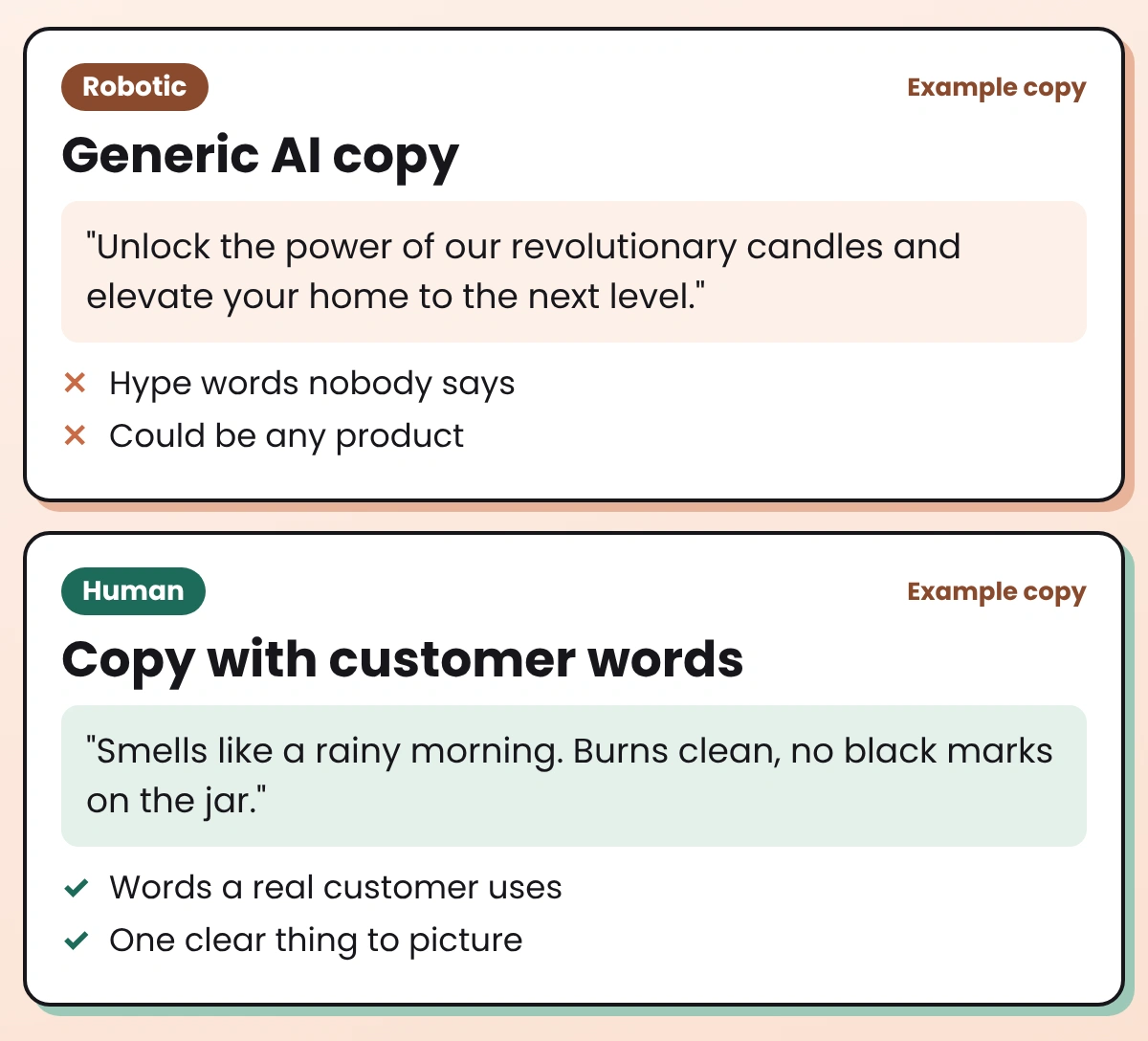
You ask for “a catchy ad”, and you get words like unlock, elevate and game-changing. It could be an ad for any product, from any company. Your customers scroll past it, because it sounds like everything else they scroll past.
If your AI copy feels bland and full of hype, you’re not alone. And it’s not because ChatGPT is bad at writing. It’s because it knows nothing about your customer until you tell it.
The fix is simple. Give it real words from real customers, ask for one clear benefit, and set simple limits.
In this post, I’ll share 6 simple prompts for ChatGPT for marketing copy: ads, product pages, emails and a one-week launch plan. Set aside about 30 minutes, and you’ll leave with copy that sounds like your own customers. You’ll also get an easy 3-check edit so the final copy doesn’t sound like a robot.
In short
On this page
“My AI copy is bland and full of hype words. What am I doing wrong?”
Marketing copy is writing that helps a reader take one action: click, buy, sign up, reply. An ad, a product page, an email subject line and a button label are all marketing copy.
When you give ChatGPT almost nothing, it fills the gaps with the safest words it can find. That’s why short, vague prompts give you vague, hypey copy. The fix is not a magic prompt. The fix is better inputs.
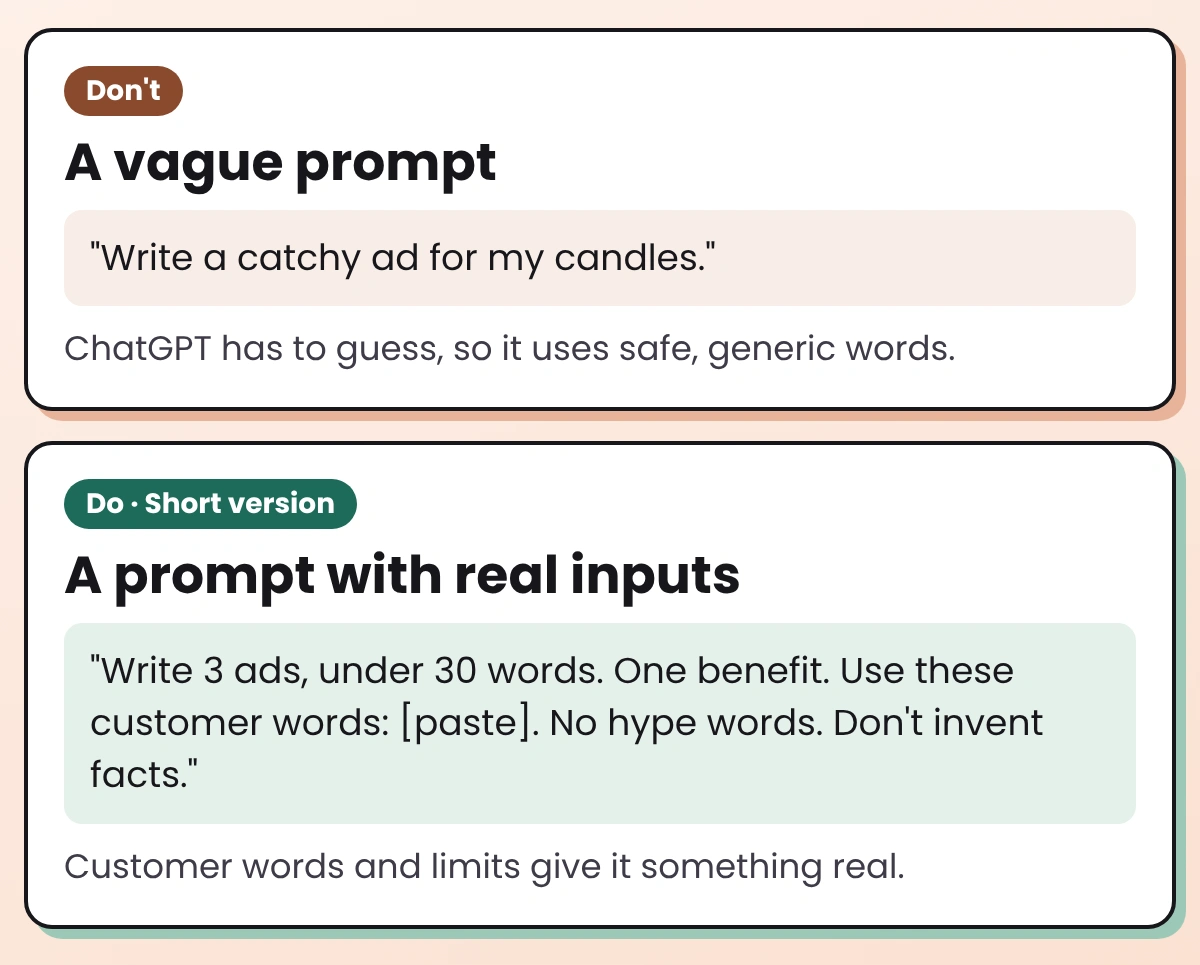
I use a simple recipe for every prompt in this post. I call it the 4-Part Copy Prompt:
“ChatGPT doesn’t know my customer.”
That’s true, and it’s the biggest reason AI copy feels flat. The good news: your customers have already told you what to write. You only need to collect it. I call this the customer-words file. It’s just one note with 10 to 20 real phrases.
Where to find them:
Only copy words people wrote to you or about your product. Don’t paste private details like names, emails or order numbers into ChatGPT.
Paste your reviews, emails or comments into ChatGPT and ask it to sort them. It must quote, not rewrite:
You are helping me understand my customers. Below is real feedback from them.
Don't rewrite or improve anything. Quote their exact words.
Give me:
1. The 5 problems they mention most, each with 1-2 exact quotes
2. The 5 things they say they like, each with 1-2 exact quotes
3. Any word or phrase they repeat
4. Any question they ask before buying
If something is not in the text, don't add it.

Customer feedback:
[paste reviews, emails or comments here]
Save the result. You’ll paste it into every prompt below. Example (made-up candle shop, your own file will differ): Problem: “my old candle burned out in a week.” Likes: “it smells like fresh bread, not perfume.” Repeated phrase: “cozy”. Question before buying: “how long does it burn?”
This is where ChatGPT is a real time-saver. Writing variations is slow for humans and quick for AI. Just keep the limits tight.
You are a copywriter. Write 5 short ad versions for my product.
Product: [what it is, in one sentence]
Who it's for: [one type of customer]
The ONE benefit to focus on: [one benefit]
Customer words to borrow from (use their phrases, don't copy whole sentences):
[paste from your customer-words file]
Rules:
- Under 30 words each
- Plain, friendly words, like talking to one person
- Don't use: amazing, game-changing, revolutionary, unlock, elevate, ultimate
- Don't invent prices, results, numbers or reviews
- End each one with a simple call to action
Label the versions A to E.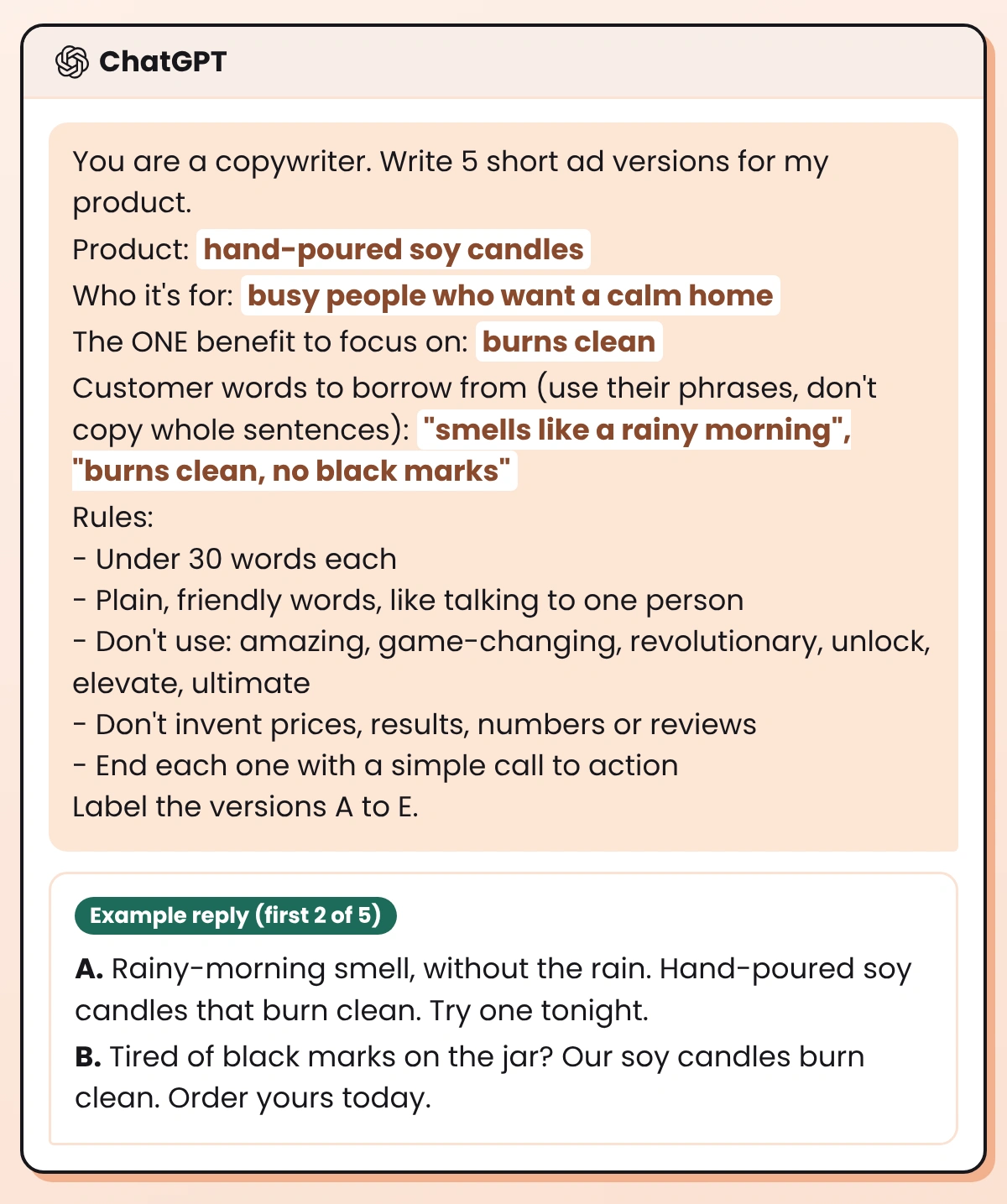
Pick the two best versions and edit them yourself (see the edit section below). Then test them against each other. ChatGPT can’t tell you which one will work. Only your audience can.
Many product pages list features. Customers want to know one thing first: will this fix my problem? A simple order helps: problem, benefit, proof. ChatGPT can draft the first two. The proof must come from you.
Write one product page section for my product, in this order:
1. Problem: 2 sentences, in my customers' words
2. Benefit: 2 sentences about the ONE benefit
3. Proof: write [ADD MY PROOF] here. Don't invent reviews, numbers or results.
Product: [what it is]
Customer words: [paste from your customer-words file]
Rules: simple words, short sentences, no hype words (amazing, game-changing, revolutionary), no claims I can't back up.
Replace [ADD MY PROOF] with something real: a true customer quote you have permission to use, your return policy, how long you’ve been selling, or the materials you use.
Write a short email (under 120 words) to my subscribers about [offer or topic].
Give me 5 subject line options under 50 characters, with no all-caps and no exclamation marks.
Tone: friendly, like a note from one person to another.
Include one clear call to action: [what I want them to do].
Use this customer language where it fits: [paste a few phrases].
Don't invent discounts, deadlines or results.
Check the “from” name and the offer yourself before you send. If you also want to reuse a blog post as short posts, my guide on how to turn a blog post into social media posts uses the same idea.
This happens to almost everyone. You spend weeks on the product and one day on the announcement. A simple plan fixes it. One prompt can give you the skeleton of a week. You then fill each day with your own details.
Plan a 7-day launch for [product or offer]. Give me one short message idea per day.
Mix: 2 emails, 3 social posts, 1 story-style post, 1 reminder.
For each day: the goal, the one message, and a suggested opening line.
Base the messages on these customer problems: [paste]
Rules: no hype words, no fake urgency, no invented discounts or deadlines. Mark any place where I need to add a real detail with [ADD MINE].
Then write each day’s message with Prompt 2 or Prompt 4. Doing one day at a time keeps the copy specific. If you promote other people’s products, read my post on how to use AI for affiliate marketing without losing trust too.
It might, and that’s normal. Treat the first draft as a rough draft. Then do a quick human pass. Here is my 3-check edit:
You are my copy editor. Below is a draft of marketing copy.
Don't rewrite it from scratch. Do this:
1. List every hype word or empty phrase
2. Mark every claim that needs proof: CHECK
3. Mark places where a real detail would help: ADD MINE
4. Suggest a plainer version of the 3 weakest sentences
Don't add new facts, numbers or promises.

Draft:
[paste your copy]
For a longer editing routine, see how to edit AI content so it sounds human.
Watch out
Good to know
If you write for bloggers or a blog audience, the same inputs-first idea works for long posts. See how to write a blog post with AI that still sounds like you, or pick tools in the free AI tool stack for bloggers.
Your 30-minute test
One real ad you can test is worth more than ten “perfect” drafts.
Marketing copy is writing that helps a reader take one action, such as click, buy, sign up or reply. Ads, product pages, emails and button labels are all marketing copy.
A good one includes who the ad is for, one benefit, your customers’ own words, a length limit and a list of words not to use. Also tell it not to invent prices, results or reviews.
Mostly for first drafts, ad and subject line variations, and ideas. A person should still edit the final copy and check every claim.
It can write good drafts. Whether the copy converts depends on your offer, your audience and testing. No prompt can promise results, so test two versions and learn from them.
Give it real customer words, ask for one benefit, ban hype words, and then edit by hand. Add one real detail and read the copy out loud.
Often yes, but check your client agreement first and be open about how you work. Edit and fact-check everything before it goes out, because you are responsible for the final copy.
ChatGPT doesn’t make bad copy on purpose. It makes generic copy when it has nothing real to work with.
Collect your customers’ words. Ask for one benefit. Set limits and ban the hype. Then add the proof and the human touch yourself. That’s the simplest way to use ChatGPT for marketing copy and still sound like you.
You can do this. It’s easier than it looks.
Want simple, copy-paste AI workflows like this one? Grab my free AI Workflow Starter Kit. And for more guides, browse the blog.

12+ years in digital marketing. I test every workflow on real work before I share it, free tools first.
More about me →Steps, a copy-paste prompt and the limits I found. Free, nothing to buy.
Get the Free Starter Kit →